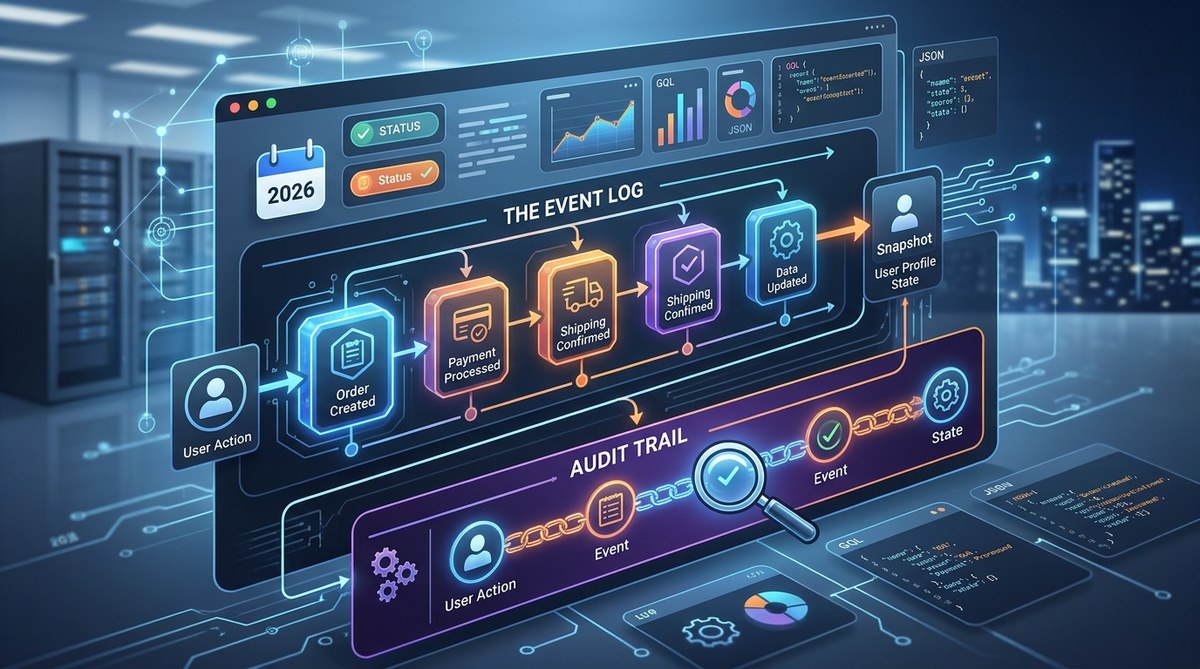
You are a software architect staring at a compliance requirement that makes your stomach hurt. The product owner wants a complete history of every state change. The auditor wants to know who did what, when, and why. Your current CRUD database can answer the “what is the current state” question, but it cannot tell you how you got there without a mess of timestamp columns and change logs. There is a better way.
Event sourcing stores every change as an immutable event. Instead of updating a row, you append a fact. The current state is a derived projection of all past events. This pattern gives you a perfect audit trail by default. No extra logging tables. No after-the-fact reconciliation. Every question about the past is answerable from the event store itself.
Event sourcing transforms your database into an immutable ledger of facts. In 2026, this pattern is the gold standard for systems that require strong audit trails and compliance with regulations like SOC 2 and GDPR. You get free audit logs, time travel queries, and the ability to replay history for debugging. The tradeoff is increased storage and a steeper learning curve for your team.
What Makes Event Sourcing a Natural Fit for Audit
Traditional CRUD systems overwrite data. When a user updates their email address, the old value disappears. You might add a separate audit table to capture the change, but that table lives outside your core business logic. It is easy to forget to log something. It is even easier for a developer to skip the audit hook during a late-night deployment.
Event sourcing solves this by making the event the source of truth. Every command that changes state produces an event. That event is stored in an append-only log. The current state is rebuilt by replaying those events in order. If you have the events, you have the full history.
This approach aligns perfectly with compliance frameworks that require non-repudiation. You cannot delete or alter an event without breaking the chain. Most event stores use cryptographic hashing or sequential IDs to ensure immutability. Auditors love this because it removes the trust question. The system itself proves the data has not been tampered with.
How to Design an Auditable System with Event Sourcing in 2026
Building an auditable system with event sourcing requires more than just picking a library. You need to think about event structure, storage, and replay mechanics from day one. Here is a practical process that works for teams adopting this pattern today.
A 5 Step Process for Implementation
-
Define your events as business facts. Name each event in the past tense past tense. “UserEmailChanged” is better than “UpdateEmail”. Include a timestamp, a user ID, and the data that changed. Do not include derived state. Keep events small and focused.
-
Choose an event store that supports snapshots. Replaying every event from the beginning of time is slow. Use snapshots to capture the state at a point in time. Store the snapshot alongside the event stream. When you need to rebuild state, load the latest snapshot and replay only the events after it.
-
Build idempotent projections. Your read models should produce the same result no matter how many times you replay the events. This is critical for debugging and for recovering from failures. Test this by replaying events in a staging environment before every release.
-
Implement a command validation layer before events are written. Do not let invalid data into the event store. Validate commands against the current state before you generate the event. This keeps your event stream clean and your projections predictable.
-
Set up a monitoring alert for event store growth. Event sourcing uses more storage than CRUD. That is expected. But unbounded growth can hurt performance. Use a tool to track event volume per aggregate and set alerts when a stream grows beyond a threshold you define.
Common Mistakes and How to Avoid Them
| Mistake | Why It Hurts | How to Fix It |
|---|---|---|
| Storing too much data in a single event | Makes projections slow and increases storage costs | Keep events focused on one business change. Split large events into smaller ones. |
| Forgetting to version your events | Old events break projections after a schema change | Add a version field to every event. Use a migration strategy for old events. |
| Skipping snapshot creation | Rebuilds take too long as the event store grows | Create snapshots after a configurable number of events, like every 100 events per aggregate. |
| Using the event store for queries | Event stores are write-optimized, not read-optimized | Build separate read models using projections. Use a cache or a dedicated read database. |
| Ignoring the eventual consistency tradeoff | Users see stale data if projections lag | Set clear expectations with stakeholders. Use synchronous projections for critical paths when needed. |
“Event sourcing gives you a free audit trail, but only if you treat events as immutable facts. Once you allow mutation of the event stream, you lose the trust that makes the pattern valuable.” – A senior architect who learned this the hard way.
Practical Techniques for Auditors and Developers
Auditors want three things: completeness, accuracy, and non-repudiation. Event sourcing delivers all three if you follow these techniques.
Techniques That Work in Production
-
Use cryptographic event hashes. Link each event to the previous one using a hash. This creates a chain that makes tampering detectable. Some teams use SHA-256 for this. The hash is stored alongside the event metadata.
-
Store the user context in every event. Include the user ID, IP address, and a session identifier. This gives auditors the full context of who made a change and from where. Do not rely on external logs for this information.
-
Build a dedicated audit API. Expose a read-only endpoint that returns the event stream for a given aggregate. This allows auditors to query the system without accessing the production database. Rate-limit this endpoint to prevent abuse.
-
Schedule regular event replay tests. Once a quarter, replay the entire event stream in a staging environment. Compare the resulting state to a known baseline. This catches data corruption and projection bugs before they become production incidents.
When Event Sourcing Is Not the Right Choice
Event sourcing is powerful, but it is not a silver bullet. Avoid it when:
-
Your system requires strong consistency across many aggregates. Event sourcing works best with eventual consistency. If you need transactions that span multiple aggregates, you will fight the pattern.
-
Your team is new to distributed systems. Event sourcing adds complexity around event ordering, idempotency, and projection rebuilds. If your team is still learning basic microservices patterns, start with a simpler approach.
-
Your storage costs are a primary concern. Event sourcing uses significantly more storage than CRUD. If you are dealing with petabytes of data and a tight budget, consider a hybrid approach where only critical aggregates use event sourcing.
The Developer Experience in 2026
The tooling for event sourcing has matured significantly by 2026. Most major languages have libraries that handle the boilerplate. Event stores like EventStoreDB, PostgreSQL with logical replication, and even Kafka are common choices. The community has settled on standard patterns for event versioning and snapshot management.
What has not changed is the need for discipline. Event sourcing requires your team to think in terms of facts, not state. Every developer on the team needs to understand that events are permanent. There is no “undo” button. You can issue a compensating event, but you cannot delete the original.
If you are coming from a CRUD background, this shift takes time. Start with one aggregate that has high audit requirements. A payment system or a user profile change log is a good candidate. Prove the pattern works before you expand it to the rest of the system.
Building Your First Auditable System
Let us walk through a concrete example. You are building a system that manages employee expense reports. Your compliance team needs to know every time a report is submitted, approved, rejected, or modified.
In a CRUD system, you would create an expense_reports table and an expense_report_audits table. Every update to the main table would require a corresponding insert into the audit table. Over time, these two tables can drift out of sync. A bug in the audit code means lost history.
With event sourcing, you store events like ExpenseReportSubmitted, ExpenseReportApproved, ExpenseReportRejected, and ExpenseReportModified. Each event contains the full context of the change. The current state of the expense report is a projection built from these events. The audit trail is the event stream itself.
To answer an auditor’s question about who approved a specific report, you query the event stream for that report’s ID and filter for ExpenseReportApproved events. The answer is in the event data. No joins. No separate audit table. No questions about data integrity.
Integrating with Existing Systems
You do not need to rewrite your entire application to use event sourcing. A common pattern in 2026 is to wrap event sourcing around a single bounded context. Your legacy CRUD system handles the rest.
Use a message broker like Kafka to publish events from your legacy system. A new event-sourced service consumes those events and builds its own projections. Over time, you can migrate more functionality into the event-sourced service. This approach gives you the audit benefits without a big bang rewrite.
If you are interested in other patterns that complement event sourcing, check out our guide on mastering modern web frameworks for faster development. It covers CQRS and how it pairs with event sourcing for read-heavy systems.
Why Your Next Project Should Start with Event Sourcing
Compliance requirements are not going away. Regulations like SOC 2, HIPAA, and GDPR demand that you can prove what happened in your system. Event sourcing makes that proof a first-class citizen of your architecture. You are not bolting audit on after the fact. You are building it in from the start.
The year 2026 is a great time to adopt this pattern. The tooling is mature. The community has documented the pitfalls. Your team can learn from the mistakes of early adopters instead of repeating them.
Start small. Pick one bounded context with high audit value. Build your event store. Write your projections. Show your compliance team the immutable audit trail. They will ask why you did not do this sooner.
And when your auditor asks for a record of every change made to a specific user account last quarter, you will not need to scramble. You will query the event stream, hand them the results, and go back to building features. That is the power of event sourcing for auditable systems.