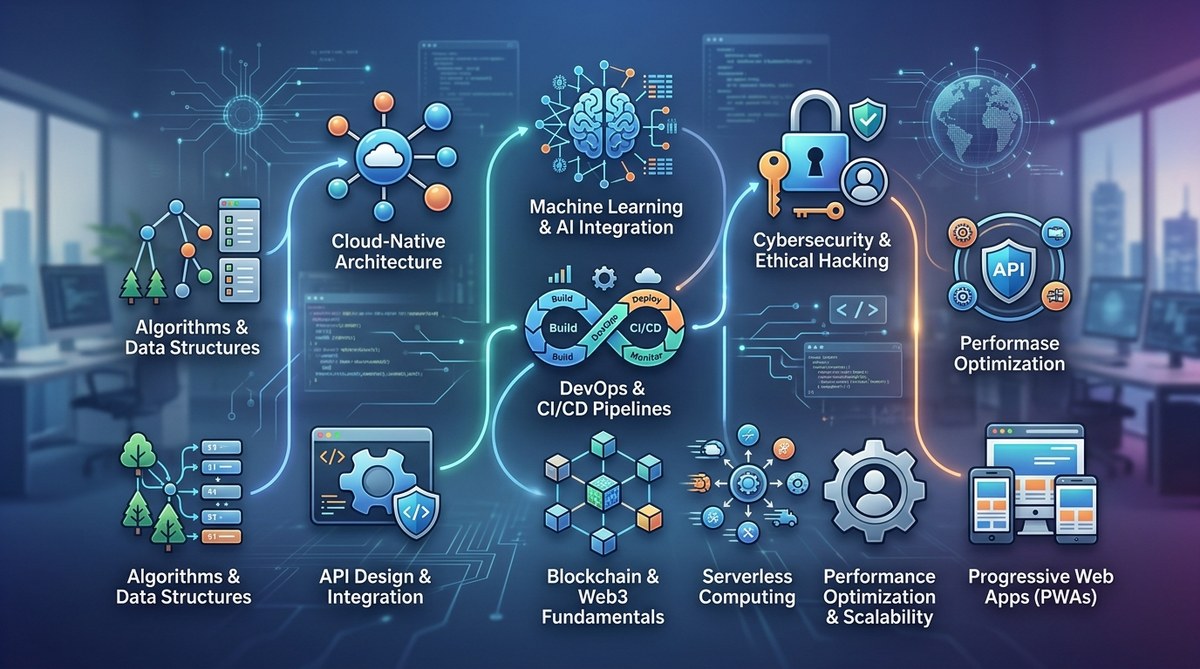
The tech landscape shifts fast. One year a framework is everywhere, the next year it fades into maintenance mode. But the underlying programming concepts 2026 demands are more stable. They outlast any single tool or library. If you are a junior or mid level developer looking to level up, focusing on these core ideas will give you the biggest return on your time. You do not need to learn everything. You need to learn the right things.
Mastering these ten programming concepts in 2026 will help you build modern apps with confidence, collaborate better with your team, and prepare for senior roles. You will learn how AI changes coding patterns, why type safety matters more than ever, and which systems thinking skills separate good developers from great ones.
Why These Concepts Matter Right Now
The market is changing. Companies are shipping faster, using smaller teams, and expecting developers to own more of the stack. Cloud costs are under a microscope. AI assistants write boilerplate code, which means the value you add shifts toward architecture, security, and reliability. Each concept on this list directly addresses one of those pressures.
If you are reading this, you probably already know the basics of loops, conditionals, and functions. That is a solid foundation. Now it is time to build the mental models that let you tackle larger systems with less stress.
1. Thinking in Types and Contracts
Type safety is no longer a nice to have. It is a productivity multiplier. Languages like TypeScript, Rust, and Go have shown that catching bugs at compile time saves hours of debugging later. When you write a function signature, you are documenting your intent for your future self and your teammates.
Spend time learning how to express business rules through types. In TypeScript, that means mastering discriminated unions, generics, and branded types. In Rust, it means understanding the borrow checker and the type system. The discipline carries into any language you use.
If you want to see how types protect you in a systems language, try getting started with Rust for systems programming in 2026. The learning curve is real, but the safety gains are worth it.
2. Asynchronous Programming and Concurrency Models
Your app will wait. It will wait for a database query, an API call, a file read. The question is whether your users wait too. Asynchronous programming lets you handle many tasks without blocking the main thread.
In 2026, every major language has mature async support. JavaScript has promises and async/await. Python has asyncio. Rust has tokio. The concept is the same: do not waste cycles sitting idle.
Learn the mental model of the event loop. Understand how callbacks, promises, and async/await relate. Know when to use concurrent patterns and when parallelism is the better fit. These skills apply everywhere.
For a deeper look at this topic in JavaScript, check out mastering async programming in JavaScript for better performance.
3. Data Modeling and Query Thinking
Every application manages state. That state lives somewhere: a relational database, a document store, a cache, or a queue. Understanding how to model that data is more important than memorizing SQL syntax.
You need to think in terms of relationships, indexes, and access patterns. A poorly designed schema makes every query slow. A well designed one makes your app feel instant.
| Data Store Type | Best For | Common Mistake |
|---|---|---|
| Relational (PostgreSQL) | Structured data with relationships | Overusing JSON columns for relational data |
| Document (MongoDB) | Flexible schemas, nested data | Ignoring index limits on large collections |
| Key-Value (Redis) | Caching, session storage | Storing large objects without TTL |
| Graph (Neo4j) | Connected data, recommendation engines | Using it for simple CRUD apps |
If you work with databases often, dedicate time to mastering NoSQL databases for modern web applications and understanding database indexing techniques for faster queries.
4. API Design Beyond REST
APIs are the glue of modern software. Every team builds them, and every team consumes them. Getting the design right determines how easy your service is to use and maintain.
Go beyond basic REST. Learn about GraphQL for flexible queries, gRPC for high performance internal services, and webhooks for event driven architecture. Understand idempotency, pagination strategies, rate limiting, and error formatting.
A good API hides complexity. A bad one exposes it. Your goal is to make consumers feel like the API reads their mind.
5. Containerization and Declarative Infrastructure
Developers in 2026 do not just write code. They ship it. Containers give you a consistent environment from your laptop to production. Dockerfiles, compose files, and Kubernetes manifests are now part of the daily conversation.
You do not need to be a DevOps specialist. You do need to understand what a container is, how images are built, and why declarative config beats manual setup. Knowing how to write a Dockerfile that is efficient and secure is a baseline skill.
For developers who want to see how open source tools simplify this workflow, take a look at top open source frameworks every web developer should know in 2026.
6. Testing Strategy That Actually Works
Testing is not about reaching a coverage number. It is about confidence. A good test suite tells you when something breaks and helps you refactor without fear.
Build a strategy that covers three layers:
- Unit tests for individual functions and components. These run fast and catch logic errors early.
- Integration tests for how pieces work together. These catch wiring mistakes.
- End to end tests for critical user workflows. These are slow but catch real world failures.
Write tests as you go. Do not treat them as an afterthought. The time you spend writing a test now saves you an incident call at 2 AM later.
7. Security as a Habit
Security is not a separate phase. It is a practice you weave into every line of code. The basics have not changed, but the attack surface has grown.
Here is a short list of habits every developer should build:
- Validate and sanitize all user input.
- Use parameterized queries to prevent SQL injection.
- Store secrets in environment variables or a vault, not in code.
- Set proper CORS headers and understand what they do.
- Hash passwords with a slow algorithm (bcrypt, argon2).
- Keep dependencies updated to avoid known vulnerabilities.
“Security is not a product, but a process. It is how you design, build, and maintain your software that determines whether you are safe.” Bruce Schneier
Build these habits now. They will protect you and your users for your entire career.
8. WebAssembly and Running Code Anywhere
WebAssembly (Wasm) started in the browser, but it has outgrown that home. In 2026, Wasm runs on servers, in edge functions, and even on IoT devices. It gives you a portable binary format that runs near native speed.
You do not need to write Wasm directly. You write Rust, Go, or C# and compile to a Wasm module. The result is code that runs in environments where JavaScript was never the right fit.
If you are curious about how this changes web performance, read up on understanding the fundamentals of WebAssembly for modern web development and understanding WebAssembly and its impact on web performance.
9. Version Control Collaboration Patterns
You know how to commit, push, and pull. That is the baseline. The next level is understanding how to collaborate at scale.
Learn trunk based development or a refined Git flow. Know how to rebase interactively, squash commits, and write clear commit messages. Understand how to resolve merge conflicts with confidence.
Version control is the backbone of team work. When you master it, you remove friction from every code review and every deployment.
For developers who want to give back to the community while sharpening these skills, getting started with contributing to popular open source projects is a great next step.
10. AI Assisted Development Without Losing Your Edge
AI coding assistants are now part of the daily toolchain. They autocomplete functions, suggest tests, and even refactor code. The skill is not in using them. It is in using them well.
Treat AI output like a junior developer’s pull request. Review it. Question it. Test it. AI can generate code, but it cannot reason about your specific business logic, edge cases, or security requirements.
Use AI to speed up the parts of coding that are mechanical. Use your own brain for the parts that require judgment. That balance is where you stay valuable.
Your Learning Path in 2026
You cannot learn all ten of these in a weekend. Pick two or three that feel most relevant to your current work. Spend a few weeks building small projects around them. Write notes, draw diagrams, and teach what you learn to a colleague.
The goal is not to check boxes. It is to build mental models that stick.
For a broader view of where the industry is heading, skim through exploring the latest trends in programming languages for 2026. It will help you decide where to invest your learning time next.
What You Build Next
The developers who grow fastest are the ones who keep learning deliberately. They do not chase every trend. They focus on concepts that transfer across languages and frameworks. The ten ideas here are exactly that kind of investment.
Start with one. Build something small. Break it. Fix it. Document what you learned. Then pick the next one. By the end of this year, you will look back and see how far you have come.
Your career is a long game. Every concept you master now makes the next one easier. Get started today.