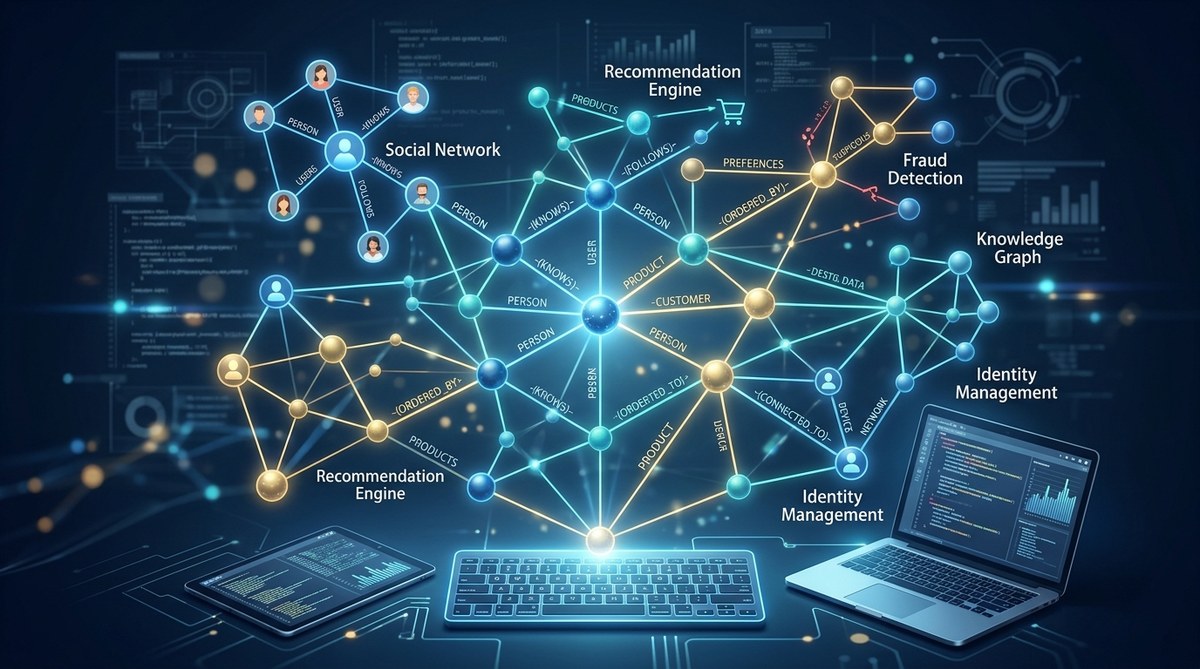
Developers and data architects are increasingly turning to graph databases to handle complex, interconnected data. Unlike traditional relational systems, graph databases excel at modeling relationships, making them invaluable in many modern projects. From personalized recommendations to fraud detection, these databases are redefining how businesses understand and utilize their data.
Graph databases are powerful tools for managing highly connected data. They shine in use cases like recommendation systems, fraud detection, and customer insights, enabling faster, more intuitive data analysis and decision making in modern development projects.
Understanding the core of graph databases
Graph databases organize data as nodes (entities) and edges (relationships). This structure naturally mimics real-world connections, making complex queries faster and more straightforward. Unlike relational databases, which require multiple joins to navigate relationships, graph databases allow direct traversal of connections. This makes them ideal for use cases where understanding and analyzing relationships is key.
The graph data model supports properties on nodes and edges, adding context such as timestamps, categories, or status. This flexibility allows developers to model real-world scenarios more intuitively, supporting dynamic and evolving data landscapes.
Practical use cases of graph databases in modern development
Many industries now rely on graph databases to solve specific challenges that traditional systems struggle with. Here are some of the most impactful use cases:
1. Personalized recommendation engines
Recommendation engines are everywhere, from e-commerce to streaming services. They analyze user preferences and behaviors to suggest products, movies, or content. Graph databases excel because they can quickly traverse relationships between users, items, and preferences.
For instance, a streaming platform can use a graph to connect viewers to genres, actors, and viewing history. When a user watches a new show, the system can identify similar viewers and recommend content based on shared tastes. Companies like Netflix and Spotify leverage graph databases for smarter, more relevant suggestions.
2. Fraud detection and prevention
Financial institutions face constant threats from fraudsters. Detecting suspicious activity requires analyzing complex patterns across transactions, accounts, and behaviors. Graph databases enable real-time analysis of these relationships.
For example, a bank can model transactions as edges between accounts. Unusual patterns, like multiple accounts linked to a common device or IP address engaged in suspicious exchanges, become easier to identify. Fraud rings often operate through interconnected accounts, and graph traversal can reveal these hidden networks faster than traditional methods.
3. Customer 360 and master data management
Creating a comprehensive view of each customer helps businesses tailor marketing, improve service, and foster loyalty. Graph databases connect disparate data points such as purchase history, support interactions, social media activity, and more.
A retail chain might use a graph to unify customer data across stores and online channels, enabling a single, unified profile. This holistic view supports targeted campaigns and personalized experiences that boost customer satisfaction.
4. Supply chain and logistics management
Supply chains involve complex relationships between suppliers, manufacturers, warehouses, and transportation providers. Graph databases provide end-to-end visibility, making it easier to identify bottlenecks or optimize routes.
A logistics company can model shipments, routes, and warehouses as a graph. When disruptions occur, they can quickly analyze alternative paths or predict delays, reducing costs and improving delivery times.
5. Network and IT infrastructure management
Managing IT systems involves understanding dependencies between servers, applications, and networks. Graph databases facilitate real-time monitoring and troubleshooting.
For example, a telecom provider can model their network components as a graph. When a node fails, the system can analyze connected dependencies to pinpoint the issue and determine the impact on other services swiftly.
6. Social network analysis and identity management
Social media platforms use graph databases to analyze relationships, interactions, and content sharing. They help in friend suggestions, content personalization, and community detection.
In identity management, graph models can detect anomalies, such as duplicate accounts or compromised credentials, by analyzing connection patterns.
Techniques for leveraging graph databases effectively
Implementing graph databases involves specific techniques to maximize their potential:
| Technique | Description | Common Mistakes |
|---|---|---|
| Modeling relationships naturally | Map real-world entities and their associations directly | Overcomplicating the graph with unnecessary nodes |
| Using appropriate algorithms | Apply graph algorithms like shortest path or community detection | Relying solely on basic traversal methods |
| Indexing key properties | Speed up queries by indexing frequently accessed attributes | Ignoring property indexing, leading to slow queries |
| Maintaining data consistency | Regularly update and validate relationships | Forgetting to update relationships after data changes |
“Design your graph model to mirror real-world relationships as closely as possible. This approach simplifies queries and enhances performance,” advises data architect Jane Doe.
Challenges and pitfalls to watch out for
While graph databases provide many advantages, they are not perfect for every scenario. Common pitfalls include:
- Overly complex models that become difficult to maintain
- Lack of proper indexing leading to slow query response times
- Data inconsistency due to unverified relationship updates
- Scalability issues with extremely large graphs if not designed carefully
A balanced approach involves planning your schema thoughtfully, monitoring performance, and regularly refining your data model.
Building a robust graph database strategy
To make the most of graph databases, consider the following steps:
- Identify key relationships in your data that drive your application logic.
- Model data intuitively, keeping the structure simple and reflective of real-world connections.
- Implement efficient indexes on properties frequently used in queries.
- Regularly analyze and optimize your graph for performance bottlenecks.
- Leverage graph algorithms to uncover hidden insights and patterns.
- Ensure data consistency through validation and update protocols.
By following these practices, you can unlock the full potential of graph databases in your projects.
Practical tips to get started with graph databases
- Begin with a clear understanding of your data relationships.
- Use visual modeling tools to map out your graph schema.
- Experiment with native query languages like Cypher or Gremlin.
- Explore open-source options like Neo4j or JanusGraph to prototype.
- Connect your graph database to analytics tools for advanced insights.
Final thoughts on harnessing graph databases for modern projects
Graph databases are transforming how developers approach complex data challenges. They enable faster, more natural data traversal and uncover relationships that traditional databases often miss. Whether you’re building recommendation engines, detecting fraud, or managing intricate supply chains, integrating graph technology can elevate your project’s capabilities.
Start small by modeling a key relationship in your system. As you gain confidence, expand your graph model to uncover deeper insights and efficiencies. Remember, the true power of graph databases lies in their ability to mirror the interconnectedness of the real world, making your data work smarter and faster.
Incorporating graph databases into your development toolkit offers a fresh perspective on data management. It’s time to rethink how relationships are handled and leverage this technology to solve modern, interconnected problems effectively.