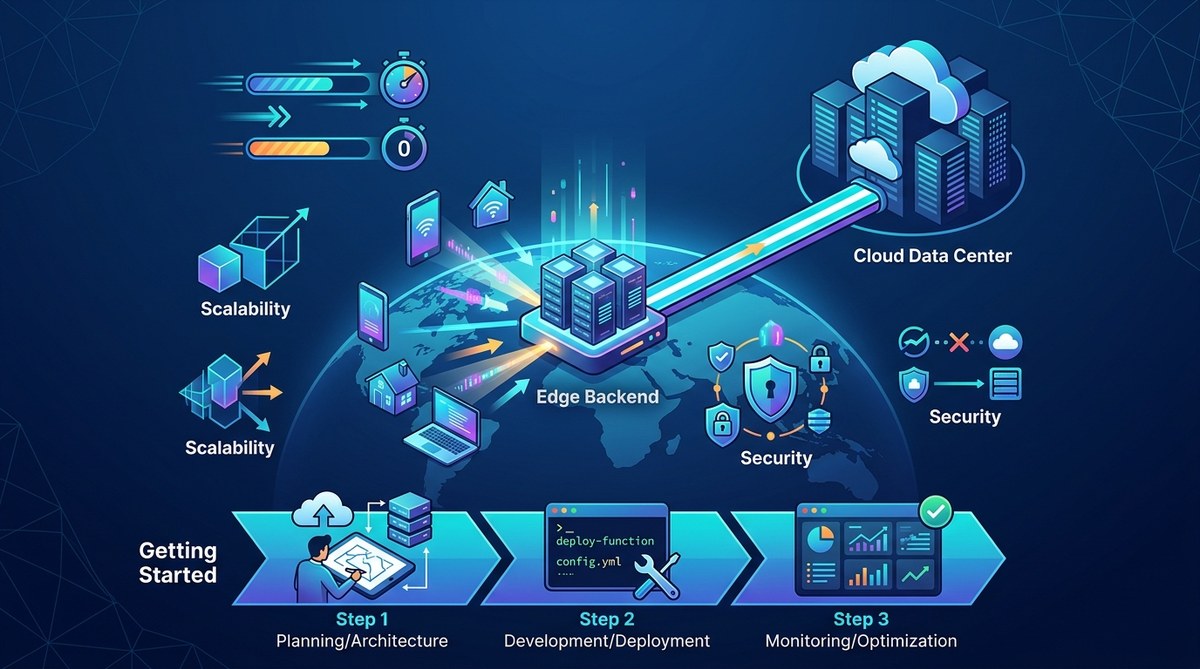
You have probably seen the benchmarks. A request that takes 200 milliseconds from a central cloud region drops to under 20 milliseconds when served from a node in the same city as the user. That difference is not just about speed. It changes how you design your backend. Edge computing moves your application logic closer to where the data originates and where the user waits. For a backend developer evaluating modern distributed architectures, the question is no longer whether edge computing works. The question is how to adopt it without breaking your existing systems.
Edge computing for backend services reduces latency by processing data near the user instead of a central cloud hub. This guide covers the core architectural patterns, real world tradeoffs like cache invalidation and data consistency, and a numbered migration plan to move one service to the edge. You will learn how to evaluate if your workload fits edge deployment and which tools support it in 2026.
What Edge Computing Means for Your Backend
Edge computing is not a new data center model. It is a distribution model. Instead of running your entire backend in one or two cloud regions, you deploy small instances of your service across many geographic points. These instances sit at the “edge” of the network, often inside a content delivery network (CDN) or on provider nodes in dozens of cities.
For the backend developer, this changes the mental model. Your service is no longer a monolith sitting behind a load balancer. It becomes a set of stateless or state aware functions that run close to your users. The core database might stay centralized, but the logic that reads and writes data can live on the edge.
This approach works especially well for:
- Read heavy APIs where latency matters
- Authentication and session validation
- Localized content personalization
- Real time data aggregation from IoT devices
- Image and video processing pipelines
If your service processes a request, fetches some data, and returns a response, you have a candidate for edge deployment.
The Architecture Shift: Stateless Functions and Global State
The hardest part of moving to the edge is handling state. Your backend logic can run anywhere, but your database cannot replicate instantly across 50 locations. You must decide which data lives at the edge and which stays in a central source of truth.
Here is how successful teams approach this split.
Read heavy, write light workloads
These are the easiest to migrate. Cache user profiles, product catalogs, or configuration data at the edge. Write operations go directly to your central database. The edge node reads from a local cache and invalidates it when a write occurs. This pattern is sometimes called “cache aside” with a global invalidation channel.
Session and token validation
Store a short lived session token or JWT in a cookie. The edge node validates the token without calling your central auth service. This removes a round trip for every request. If the token is invalid, the edge can reject the request or route it to your central auth endpoint for a refresh.
Eventual consistency for writes
Some applications can accept a small delay before data is consistent everywhere. A social media “like” counter can be incremented locally and then synced to the central database. Users see their own update instantly, and everyone else sees it after a few seconds. This pattern requires careful handling of conflicts, but it is well understood.
If your application demands strong consistency on every write, edge computing becomes harder. You might still benefit from moving read operations to the edge while keeping writes centralized.
A Numbered Migration Plan: Move One Service in Five Steps
You do not need to rewrite your entire backend. Pick one service and follow this process.
-
Identify a read heavy endpoint. Look at your API logs. Find an endpoint that serves data and is called frequently. The product listing page, the user profile endpoint, or a configuration API are good candidates. Measure its current latency from different geographic regions.
-
Extract the logic into a stateless function. Your edge runtime will not have access to your full application stack. Write a small function that takes a request, fetches data from a cache or external API, and returns a response. Keep it pure. No file system writes, no long running connections.
-
Set up a global cache layer. Use a key value store that replicates to edge locations. Redis with a global replication setup or a managed edge KV store works. Your function reads from the local cache first. If there is a miss, it fetches from your central backend and writes the result to the local cache.
-
Deploy the function to an edge platform. Providers like Cloudflare Workers, Vercel Edge Functions, or AWS Lambda with Lambda@Edge allow you to deploy your function across many regions. Configure your DNS to route requests for that specific endpoint to the edge.
-
Monitor cache hit rate and latency. After deployment, watch the cache hit rate. Aim for above 80 percent. If you see a low hit rate, adjust your cache duration or pre warm the cache. Compare the p50 and p95 latency before and after. You should see a measurable drop for users far from your origin server.
Common Patterns and Pitfalls
| Pattern | What It Does | Risk | Best For |
|---|---|---|---|
| Cache aside with global invalidation | Edge reads from local cache, writes invalidate the cache via a central channel | Stale data if invalidation is delayed | Product catalogs, config data |
| Token validation at edge | Edge validates JWT or session token locally | Token revocation is not instant | Auth checks, rate limiting |
| Local increment with background sync | Edge updates a counter locally, then syncs to central DB | Data loss if edge node fails before sync | Analytics, social interactions |
| Full edge compute with central DB reads | Edge runs business logic but reads from central DB over a direct connection | Higher latency for DB reads than local cache | Compute heavy, data light workloads |
The most common mistake is treating the edge like a traditional server. You cannot rely on local disk storage, long lived processes, or sticky sessions. Your function must be stateless or use an external state store. If you find yourself needing a database connection that lasts minutes, the edge may not be the right place for that logic.
When the Edge Is Not the Right Fit
Edge computing is powerful, but it does not replace your central backend. Some workloads belong in your primary data center.
- Long running batch jobs. If a request takes more than 10 seconds to process, edge runtimes will time out. Keep these on a worker in your central infrastructure.
- Write heavy workloads with strict consistency. If every write must be immediately visible everywhere, the edge adds complexity without benefit. Centralize your writes and use edge only for reads.
- Services that depend on local hardware. If your backend talks to a GPU, a local database, or a physical device, you cannot run that logic on a distributed edge platform.
Expert advice from a senior infrastructure engineer at a major CDN company: “Start with one read only endpoint. Do not try to move your entire backend on day one. Prove the latency improvement, then expand. The teams that fail are the ones that try to rebuild their whole architecture in one sprint.”
Tools and Platforms for 2026
The ecosystem has matured. You no longer need to build your own edge infrastructure. These platforms support backend logic directly:
- Cloudflare Workers. Runs JavaScript and TypeScript functions on Cloudflare’s global network. Supports KV storage, durable objects, and direct HTTP handling.
- Vercel Edge Functions. Integrated with the Vercel platform. Good for serverless backend logic that runs before your main application.
- AWS Lambda@Edge. Part of AWS’s global edge network. Supports multiple runtimes including Node.js, Python, and Go.
- Fly.io. A newer platform focused on running full Elixir and Go applications at the edge, not just functions.
Each platform has a free tier for testing. Deploy a hello world function first. Then add your cache layer. Then move one real endpoint.
How to Evaluate Your Own Backend for Edge Readiness
Before you write any code, audit your current backend. Look for these signals.
- Do you have endpoints that are called from many geographic regions?
- Is your p95 latency higher than 100 ms for users outside your cloud region?
- Do you have a cache layer that already serves most requests?
- Can you extract a piece of logic into a function with no side effects?
If you answered yes to two or more, you have a strong candidate. Start with the endpoint that has the highest request volume and the highest latency. The payoff will be the most visible.
Connecting Edge Computing to Your Broader Skills
Moving logic to the edge often requires writing functions in JavaScript, TypeScript, or Rust. If you are a backend developer who works primarily in Python or Java, you might need to pick up a new runtime. The good news is that the concepts transfer. You still handle HTTP requests, parse JSON, and manage state. The difference is in the deployment model, not the programming fundamentals.
If you are looking to strengthen your skills for this shift, consider reading about mastering asynchronous programming in JavaScript for better performance. Edge runtimes are event driven, and async patterns are central to their performance.
You might also benefit from understanding top open source frameworks every web developer should know in 2026. Many edge platforms build on or integrate with these frameworks.
Your First Edge Deployment
Pick a Saturday morning. Choose one API endpoint. Write a function that does exactly what your current backend does, but without any file system access. Deploy it to Cloudflare Workers or Vercel Edge Functions. Route 5 percent of your traffic to the edge function. Compare the response times.
That is it. You do not need a full rewrite. You do not need a committee. You need one endpoint, one platform, and one afternoon. The results will tell you whether edge computing is right for your next backend.
Most developers who try this pattern find that the latency improvement is real and immediate. They also discover that the discipline of writing stateless functions makes their main backend better too. You will think more carefully about state, caching, and side effects. Those lessons apply whether you stay on the edge or return to your central server.
So go ahead. Deploy that first function. Measure the difference. Then decide where to go next.